The Industrial Shift
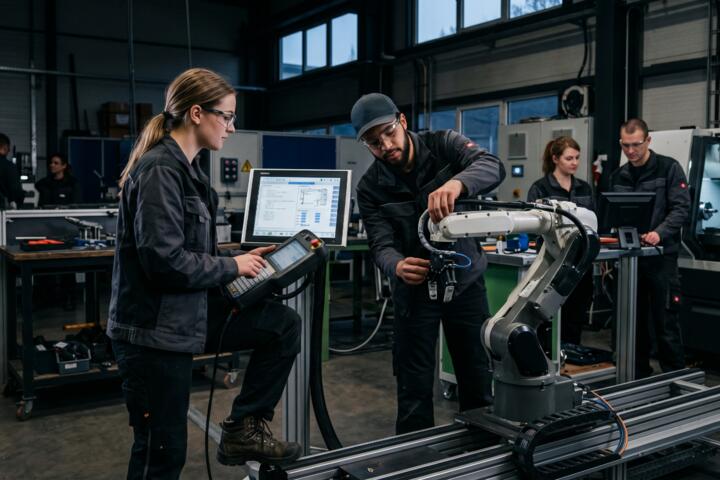
The line between white-collar and blue-collar work has blurred into a new category often referred to as "new-collar" jobs. These roles require specialized technical training but not necessarily a traditional four-year degree. Today’s technicians are as likely to use a tablet for diagnostic code analysis as they are to use a wrench or a soldering iron.
Consider a modern HVAC technician. In the past, the job was purely mechanical. Now, a specialist at a company like Carrier or Trane must manage Building Management Systems (BMS) that use AI to optimize energy consumption. They analyze real-time data streams to predict component failure before it happens, shifting the profession from reactive repair to proactive system management.
According to the Deloitte and The Manufacturing Institute 2024 study, the US manufacturing industry alone faces a shortfall of 3.8 million skilled workers by 2033. Furthermore, 75% of surveyed executives say that digital transformation has already fundamentally changed the skill sets required for entry-level production roles.
Critical Skill Gaps
Many organizations fail because they treat modern technical training as a static checkbox rather than a continuous evolution. Outdated curricula often focus on manual dexterity while ignoring the digital literacy required to operate CNC machines or automated assembly lines.
This disconnect leads to "skill stagnation," where workers can operate equipment but cannot troubleshoot the underlying software logic. When a Fanuc robotic arm stops on a production floor, the cost of downtime can exceed $22,000 per minute in automotive manufacturing. If the technician lacks the high-tech training to interface with the controller, the financial consequences are staggering.
Real-world situations often show a "knowledge silo" effect. Older, experienced workers possess the mechanical intuition, while younger hires understand the digital interface, but neither can perform the job holistically. This lack of cross-functional expertise is the primary bottleneck in modern industrial scaling.
Advanced Pathways
Integrating Digital Twins
Modern training must utilize Digital Twin technology. Services like Siemens Mechatronics Training Program (SMSCP) allow students to interact with a virtual replica of a physical system. This works because it provides a zero-risk environment to simulate catastrophic failures. In practice, a trainee can see how a 0.5mm misalignment in a virtual drive shaft affects long-term vibration data, reinforcing the precision required in the high-tech world.
The Rise of Micro-Credentials
Instead of broad degrees, industry leaders are turning to stackable micro-credentials from providers like NC3 (National Coalition of Certification Centers) or Coursera’s Google IT Support Professional Certificate. These certifications are laser-focused on specific tools, such as Snap-on diagnostics or Festo pneumatics. Data shows that workers with three or more specialized micro-certifications earn 15-20% more than those with general vocational diplomas.
Augmented Reality Mentorship
Tools like Microsoft HoloLens 2 and PTC’s Vuforia are transforming "on-the-job" training. A junior technician at a remote site can wear an AR headset, allowing a senior engineer in a different city to see what they see and overlay digital instructions on the physical hardware. This accelerates the learning curve by 40% compared to traditional manual-based instruction.
Cyber-Physical Security Skills
As industrial equipment connects to the cloud, technicians must understand cybersecurity. Training programs now include modules on securing PLC (Programmable Logic Controller) networks. Understanding the difference between a mechanical jam and a malicious firmware injection is now a core competency for modern maintenance teams at firms like Rockwell Automation.
Hybrid Mechatronics Curricula
The most effective programs combine mechanics, electronics, and computing. Vocational schools like Lincoln Tech are redesigning labs to mimic Amazon fulfillment centers, where students learn to maintain complex conveyor systems driven by AWS-integrated logic. This ensures that the worker views the machine as a node in a larger digital network rather than an isolated tool.
Modern Success Stories
A mid-sized aerospace component manufacturer in Ohio, "Precision Aero," struggled with a 30% rejection rate on their 5-axis milling machines. Their staff were traditionally trained but lacked deep knowledge of CAD/CAM integration. They partnered with Tooling U-SME to implement a customized "New-Collar" training track for 50 employees.
The program focused on real-time sensor data interpretation and precision tool-path optimization. Within 12 months, Precision Aero reduced their rejection rate to under 4%, and production uptime increased by 18%. The company reported a 250% ROI on their training investment within the first year.
Another example is "Grid-Tech Solutions," a renewable energy startup. They transitioned their wind turbine technicians from basic maintenance to "Predictive Analysts." By training them to use drone-based thermal imaging and AI-driven crack detection software, they reduced manual inspection hours by 60%, allowing their team to manage three times the number of turbines per person.
Tech Integration Matrix
| Technology Area | Traditional Role | Modern High-Tech Role | Required Toolset |
|---|---|---|---|
| Automotive | Mechanic | EV Systems Specialist | Tesla Toolbox, CAN bus |
| Manufacturing | Machine Operator | Robotics Programmer | ABB Studio, Python |
| Construction | Surveyor | BIM/Drone Coordinator | Autodesk Revit, DJI Terra |
| Energy | Electrician | Smart Grid Technician | SCADA, IoT, PowerBI |
Avoiding Pitfalls
A common mistake is investing in high-end hardware without equivalent investment in software training. Buying a $500,000 robotic cell is useless if your staff only knows how to press the "emergency stop" button. You must balance hardware acquisition with a 1:1 ratio of time spent on software logic and data analysis training.
Another error is ignoring "Soft Tech" skills. Modern technicians frequently interact with customers and management via CRM tools like Salesforce or project management platforms like Monday.com. Failing to train technicians in professional communication and digital reporting leads to data gaps in the company's operational intelligence.
To avoid these issues, implement a "continuous credit" system. Technology in the trades changes every 18 months. If your team isn't re-certifying or attending workshops at least once a year, your competitive advantage is evaporating.
FAQ
Is a degree required for these roles?
Usually, no. Most high-tech vocational roles prioritize industry-recognized certifications (like ASE, AWS, or NIMS) and demonstrated competency over a traditional four-year liberal arts degree.
What is the average salary for new-collar jobs?
Salaries vary, but specialized technicians in fields like robotics, aviation maintenance, or specialized welding often start between $60,000 and $85,000, with senior roles exceeding $120,000 in high-demand sectors.
How long does the training take?
Accelerated programs can take 6 to 12 months for initial certification, while comprehensive mechatronics apprenticeships typically span 2 to 4 years of combined work and study.
Which industries are hiring the most?
Advanced manufacturing, renewable energy (solar/wind), electric vehicle infrastructure, and automated logistics are currently seeing the highest growth in technical demand.
Are these jobs safe from AI automation?
These roles are actually "AI-augmented." While AI can analyze data, it cannot physically replace a high-precision sensor or repair a broken hydraulic line. These jobs are among the most resilient to total automation.
Author’s Insight
In my twenty years observing industrial shifts, I’ve seen that the most successful "modern tradespeople" are those who stop viewing themselves as manual laborers and start seeing themselves as "applied engineers." My advice to anyone entering this field is to master one programming language—ideally Python or PLC ladder logic—alongside your physical craft. This combination makes you indispensable in a market that is increasingly flooded with theorists but lacks practical executors. The future belongs to the person who can both code the machine and fix it when it smokes.
Summary
The modern vocational landscape offers a lucrative and stable alternative to traditional white-collar paths. By focusing on micro-credentials, embracing AR-assisted learning, and bridging the gap between mechanical and digital logic, workers can secure high-paying roles in an automated world. To succeed, individuals must commit to lifelong learning and seek out hybrid training programs that mirror real-world industrial ecosystems. Start by identifying a specific niche—such as EV diagnostics or robotic maintenance—and pursue industry-standard certifications immediately to capitalize on the current labor shortage.